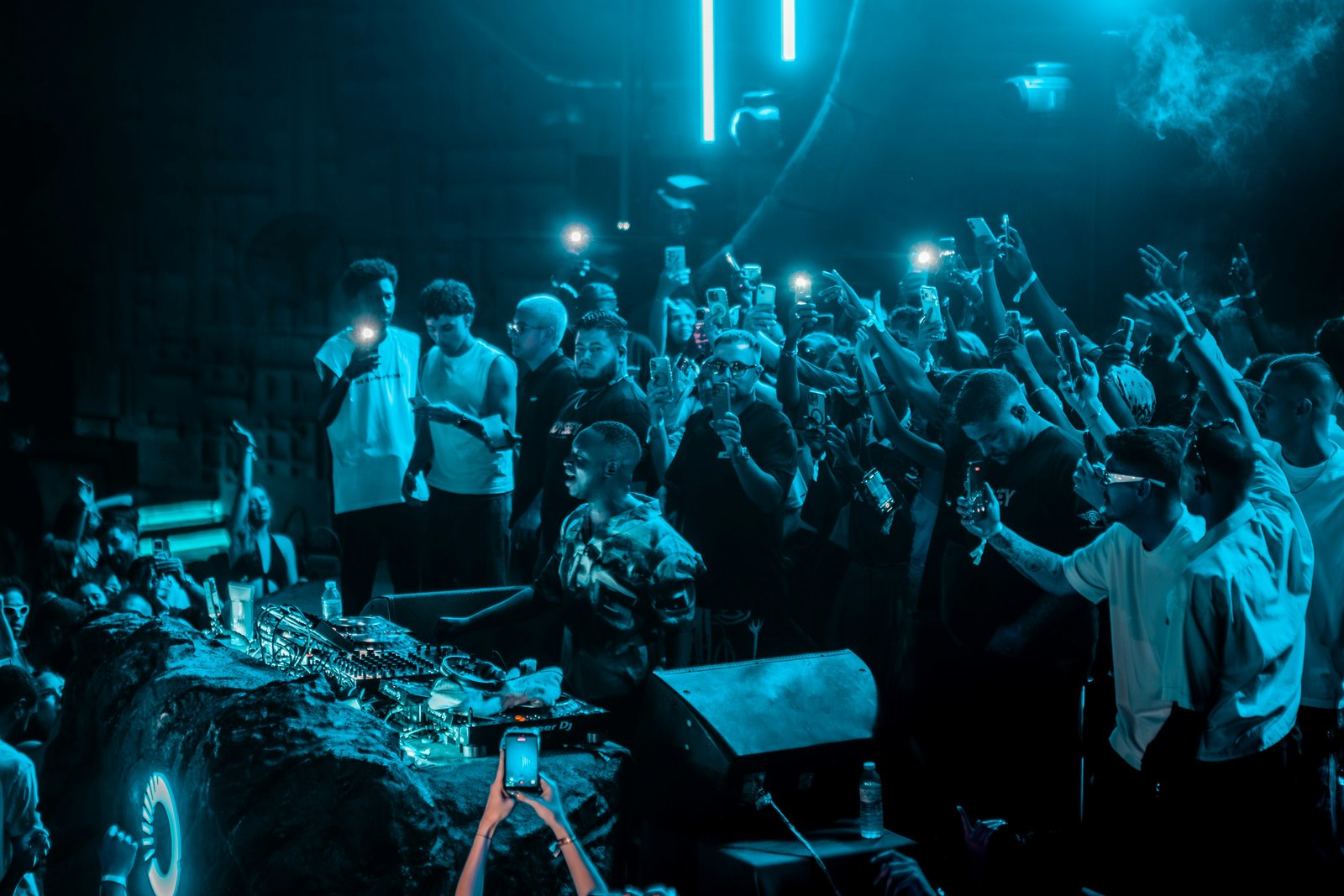
How DJs Collect Fan Emails at Gigs (When There Is No Merch Table and No Mic)
The best way for DJs to collect fan emails at gigs is to offer the night's full tracklist by email the next day. Put a QR code, NFC tag and short web address on the visuals, at the exit and by the cloakroom, then repeat the offer in a morning-after Story. Keep the form to one field, and never import the promoter's ticket buyer list.
Every guide to building a mailing list says the same thing: put a clipboard on the merch table and mention it from the stage between songs. Now try that as a DJ. There is no merch table, there is no gap between songs, the room is dark and loud, half the crowd has their phone in a pocket or a sticker over the camera, and the promoter owns every ticket buyer's email address. The band playbook does not fit.
The good news is that DJs have a better hook than any band: the question every crowd asks, which is 'what was that track?' Build your email capture around that, move most of the effort to the morning after, and a single gig can add real names to a list you own.
Why the band playbook fails DJs
A band gets a natural pause every few minutes and a microphone to fill it. You get neither, and stopping the music to plug a newsletter would be a disaster. The moments when people are receptive at a club night are narrow: the end of your set, the smoking area, the queue for the cloakroom, the walk home and, above all, the next morning when they are scrolling back through what happened.
Signal is another practical problem. Many clubs sit in basements or industrial buildings where mobile reception is terrible, so a slow sign-up page with five fields will lose people before it even loads. And some techno clubs put stickers over phone cameras at the door, which rules out QR codes inside the room entirely. Plan around all of this rather than hoping for the best.
The track ID hook: your best lead magnet already exists
The most common message any DJ receives is some version of 'ID?'. People Shazam, film the speaker stack, ask the person next to them. That curiosity is your lead magnet, and the offer is simple: tonight's full tracklist, in your inbox tomorrow.
It works because it is specific, it is instant value and it costs you nothing to produce. You already know what you played. Add a line or two about the tracks the room reacted to most, flag any unreleased IDs with a promise to tell people when they come out, and you have an email people genuinely look forward to opening.
If you record your sets, the recording is a second hook. Put it on a licensed platform such as Mixcloud or SoundCloud and send it to your list first, before you post it publicly. Being first is a benefit fans notice, and it teaches them that the list is where things happen.
Where to put the QR code in a club
Inside the room you need the venue's cooperation, so ask when you advance the show, not on the night:
- The visuals: if there is a VJ or LED wall, ask for a QR code and short web address on screen during the last 15 minutes of your set or during the changeover. - The booth front: a small, well-lit sign facing the floor, if the venue allows it. - The exit and cloakroom: a poster or card where people wait with their phones already out for taxis and messages. - The smoking area: where people talk about the night and are most likely to wonder what you played.
Label every code with the benefit, not the mechanism. 'Tonight's tracklist, scan here' gets scanned; 'join my mailing list' gets ignored. Use the same words on the screen, the sign and the Story, so people recognise the offer the second time they see it.
For camera-sticker clubs, move everything to the exit and add an NFC tag next to the code, since most modern phones open a tapped NFC link without using the camera. Always print a short, memorable web address as well, for people who would rather type it later than scan it now.
Make the sign-up page tiny: one email field, an optional city field and one button. It should load on one bar of signal. Ask for the city because it lets you tell people when you are back in their town, which is the most useful email you will ever send them.
The morning-after capture, where most sign-ups happen
Most of your sign-ups will not come from inside the club at all. They come the next day, when the crowd is reliving the night on their phones. Build a small routine around it:
- Post a Story the next morning with a clip from the set and a link sticker offering last night's tracklist. - Use a comment keyword on your post-gig Reel, such as 'comment TRACKLIST', with an approved auto-DM tool sending the sign-up link. - Pin the sign-up link at the top of your link in bio for 72 hours after every show. - Send the promoter your best clip and ask them to share it with your tracklist offer in the caption.
Answer 'ID?' comments with the same friendly line: the full tracklist goes to the mailing list. It is not a paywall, and you can still reply with the odd ID, but it points curious people towards a list you own instead of a comment thread that disappears.
Working with the promoter's data, legally
It is tempting to ask the promoter for the ticket buyers' email addresses. Do not. Under the GDPR, and in the Netherlands under the Telecommunications Act, commercial email needs the recipient's prior consent, and people who bought a ticket consented to hear from the promoter, not from you. Even DICE's messaging tool for event partners is limited to operational messages about the event itself.
Ask for help instead:
- A line in the promoter's pre-event information email pointing to your tracklist sign-up. - Your sign-up offer in their post-event thank-you email or Story. - A co-branded giveaway, such as guestlist for the next edition, with a separate, unticked checkbox that names you and says entrants will hear from you.
Keep proof of consent for every sign-up. Double opt-in, where people confirm by clicking a link in a first email, is a simple way to do that and is widely recommended in the Netherlands.
Which email tool, and what to send new fans
Most DJs can start for free. Kit's free newsletter plan covers up to 10,000 subscribers, and beehiiv's free plan covers up to 2,500. MailerLite cut its free plan to 250 subscribers in mid-2026, which makes it a weaker starting point than it used to be. Whatever you pick, tag every sign-up with the gig and city it came from.
Then send two emails, and send them fast:
- Within 24 hours: the tracklist, a short thank-you and one line on what the list gets them (first news of dates in their city, unreleased IDs, recordings before anyone else). - A week later: your next date in or near their city, or the recording of the set if you have one.
Keep the tracklist email personal and short. A subject line with the venue and date, a two-line memory of the night, the tracklist with the moments people reacted to marked, and one sentence about what comes next. Write it like a message to someone you met on the dance floor, because that is exactly who it is going to. Resist the urge to add a shop link, three social buttons and a merch banner to the first email. The first job is to be worth opening; selling can wait until the third or fourth.
Track sign-ups per gig and per hundred people in the room. Within a few months you will know which venues, placements and offers work, and that is data no platform will ever hand you.
What to do this week
- Set up a one-field sign-up page with an optional city field, and test it on a weak mobile signal. - Create a QR code, an NFC tag and a short web address that all point to it. - For your next gig, ask the promoter about screen time on the visuals and a sign at the exit, and propose the pre-event email line. - Save your tracklist during or straight after the set, so the morning email is ready to go. - Write both follow-up emails now, so the first one goes out the morning after.
One gig will not transform your list. But a DJ who plays 60 shows a year and captures even a handful of real fans each night ends the year with a list of people who have actually stood in front of them, and that is an audience no algorithm can take away.
Quick answers
Should DJs collect phone numbers or emails at gigs?
Start with email, because it is cheaper to run and people hand it over more easily in a noisy room. Text messages get read quickly but cost money per send and ask for more trust from someone who has just discovered you. Once your email list is working, invite your most engaged subscribers into a text or broadcast channel for presales.
What if the club has a no-phones or camera-sticker policy?
Respect it and move the capture outside the room. Put the QR code and an NFC tag at the exit and cloakroom, where phones come back out, and print a short web address people can type later. Then lean on the morning-after Story and comment keyword, which is where most DJ sign-ups happen anyway.
How soon after a gig should I email new sign-ups?
Within 24 hours, ideally the next morning. The night is still fresh, and the tracklist you promised is the reason they signed up, so any delay makes the email feel like an afterthought. Automate a short welcome the moment someone signs up, then send the tracklist email yourself once you have written a few lines about the set.
Is it legal to use the promoter's ticket buyer list for my newsletter?
No, not without those buyers agreeing to hear from you specifically. In the EU, commercial email generally needs prior opt-in, and people who bought a ticket agreed to hear from the promoter. Instead, ask the promoter to mention your sign-up in their event emails, or run a co-branded giveaway with a separate checkbox that names you.
Do I need a website to collect emails as a DJ?
No. Every major email tool gives you a hosted sign-up page, which is all you need for a QR code and a link in bio. A short custom domain that forwards to that page is worth the small cost, because a memorable address is easier to print on a sign and easier to type the morning after.