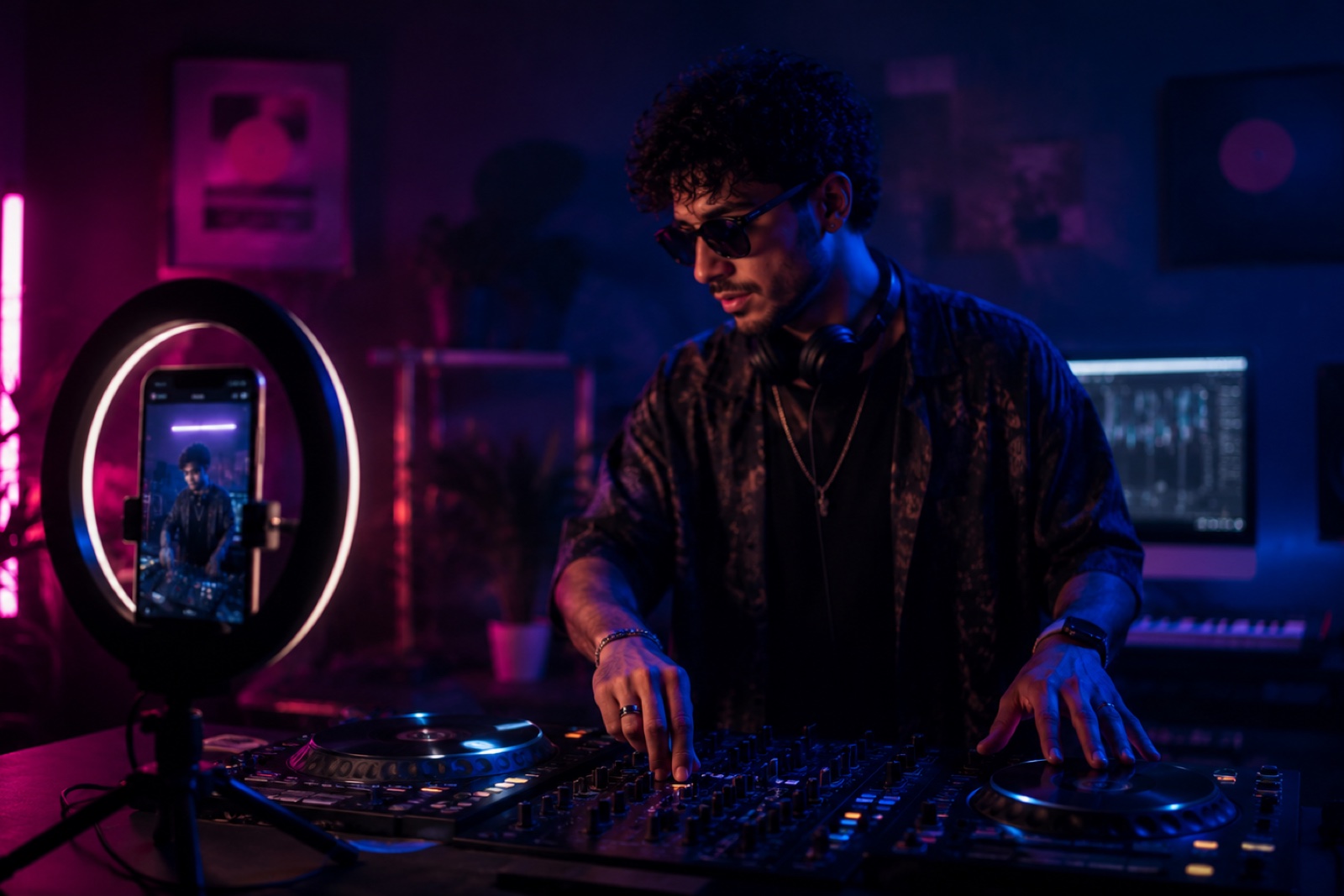
TikTok Formats That Actually Move Electronic Acts
Stop posting "DJ doing DJ things." TikTok now rewards watch time and rewatches, not motion, so the winning formats carry a hook in the first two seconds and a reason to finish: the sound-design breakdown, the unreleased ID tease, the IRL crowd reaction, and the storytime over a beat. Show a face, make a claim, and let people learn or feel something in under ninety seconds.
A clip of you mixing in a dark booth, no face, no caption, no claim, will reliably stall at a few hundred plays. That is not bad luck. TikTok ranks on watch time, completion rate and rewatches before it cares about your follower count, and longer clips around 60 to 90 seconds now tend to out-reach the old 15-second loop when they hold attention. A silent loop of hands on a mixer gives the algorithm nothing to reward: no retention curve, no reason to finish, no reason to replay. The fix is not better lighting. It is structure.
Here is the blunt truth most DJs avoid: people do not watch you because you can beatmatch. They watch because they want to learn something, feel something, or catch something they were not supposed to see. Every format below is built around one of those three. Pick the format first, then shoot. Shooting random footage and hoping it becomes a post is why most producer accounts plateau.
The two-second hook is the whole game TikTok decides your fate on the first swipe. If viewers bounce before the two-second mark, the video is capped before it leaves your follower pool. So the first two seconds cannot be a logo, a slow fade-in, or you saying hi. It has to be a visual or verbal claim.
- Open on the loudest moment, not the build. Drop first, context later. - Put a text hook on screen by the first frame: a number ("I made this bassline with one free plugin"), a stakes line ("this took 40 takes"), or a tease ("the ID everyone asked for at 2am"). - Cut the throat-clearing. No "so basically." Start mid-action. - Make the opening frame readable on mute, because most people watch the first beat with sound off.
Treat the hook as a contract: the first two seconds promise a payoff, and the rest of the clip has to deliver it before the scroll instinct returns a few seconds in. That second drop-off is where storytelling matters.
Why DJs fail: no face, no story Two patterns sink electronic accounts. First, no face. The algorithm and the audience both reward a human, and faceless booth footage reads as stock. You do not need to be a personality, but a reaction shot, a glance to camera, or you talking to the lens during a breakdown changes the retention curve. Second, no story. A 30-second clip of a track playing is not content, it is a sample. Give it a frame: what you were trying to do, what went wrong, what the crowd did. A track with a story attached gets watched twice.
The six formats that actually work These are the ones earning completions for electronic acts right now, roughly in order of reliability.
- The sound-design breakdown ("how I made this sound"). Isolate one element, the reese, the vocal chop, the kick, and show the before and after in three steps. This is the highest-retention format for producers because it promises a skill and delivers it fast. End on the full mix so people rewatch to catch the steps. - The unreleased ID tease. A short, looped section of a track nobody can stream yet, framed as a question ("should I finish this?") or a tease ("ID from Friday"). Scarcity is the hook. More on seeding this below. - The IRL crowd-reaction clip. Phone footage shot from the booth toward the crowd at the moment a drop lands. The hook is the human response: hands up, a face screaming the lyric, a wall of phones. This is the format that turns a set into an asset. Shoot the crowd, not yourself. - The duet or stitch on a fan edit. When someone edits your track or films your set, stitch it and react, co-sign it, or add the backstory. You inherit their audience and reward the behaviour you want more of. - The storytime over a beat. Talk to camera over one of your loops: how a track got signed, a gig that went sideways, why you quit your job. The beat carries the watch, the story carries the rewatch. - The process clip. The studio or B2B moment caught mid-creation. Weakest of the six on its own because it easily becomes faceless wallpaper, so always pair it with a text hook and a payoff.
How to seed an unreleased track Do not announce a finished product. Announce a recognition test. What moves electronic tracks is repetition: the same eight-bar section, posted across multiple clips, until the FYP starts recognising it. Make the unreleased section the audio bed under your process clips, your IRL footage, and your storytimes, not a one-off premiere.
- Post the same hook section in at least three different formats over two weeks so the melody becomes familiar before release. - Frame it as a decision the audience makes with you ("keep the vocal or cut it?"). Comments and saves are stronger signals than likes. - Pin the best-performing tease and reply to comments with a "coming [date]" so the thread builds anticipation. - When it drops, use TikTok's own track upload and link the official sound so every fan edit feeds your release, not a random rip. - Keep a private link (a SoundCloud secret or similar) ready for the DMs you will get from other DJs who want to play it. Crowd footage of someone else dropping your unreleased ID is free fuel.
A weekly rotation you can run A fixed rotation removes the daily "what do I post" tax. Four posts a week, each with a job:
- Monday, teach: a sound-design breakdown. Pure value, no ask. - Wednesday, tease: an unreleased ID section, framed as a question. - Friday, IRL: a crowd-reaction or set moment from the weekend (bank this footage at every gig, you will run dry otherwise). - Sunday, reactive: a duet, stitch, or storytime responding to whatever landed best that week. Rotate which unreleased section you tease so you are always warming up the next release while shipping the current one. Check your retention graph weekly, find the second where people drop, and cut two seconds before it next time.
The honest summary: your skill behind the decks is table stakes, not content. The accounts that grow treat each set, each studio session and each unfinished loop as raw material for a format with a hook and a payoff. Build the rotation, shoot the crowd, show your face, and let the track become familiar before you ever call it a release.
Quick answers
I am an introvert and I hate being on camera. Do I really have to show my face?
You do not need to perform, but you do need a human signal. A reaction shot, hands on the gear with your face half in frame, or you talking to the lens for one line during a breakdown is enough. Faceless accounts can still grow on pure sound-design value, but they tend to grow slower because both the algorithm and the audience reward a person to attach to. Start with the crowd's faces if you cannot use your own.
Won't teasing an unreleased track just get it ripped before I release it?
Rips are a distribution problem you want. The risk of obscurity is far larger than the risk of a low-quality phone rip of an eight-bar loop. Tease only the hook section, never the full track, keep your best audio for the official TikTok sound and your release, and treat any fan rip or set clip as free seeding. Familiarity at release day is worth more than secrecy.
How often should I post without burning out or tanking quality?
Four times a week on a fixed rotation beats daily posting that turns into filler. The algorithm rewards completion and rewatches, not volume, so one well-hooked 60-second clip outperforms five lazy loops. The real constraint is footage, so film aggressively at every gig and studio session and batch it, then you are editing from a bank instead of scrambling.